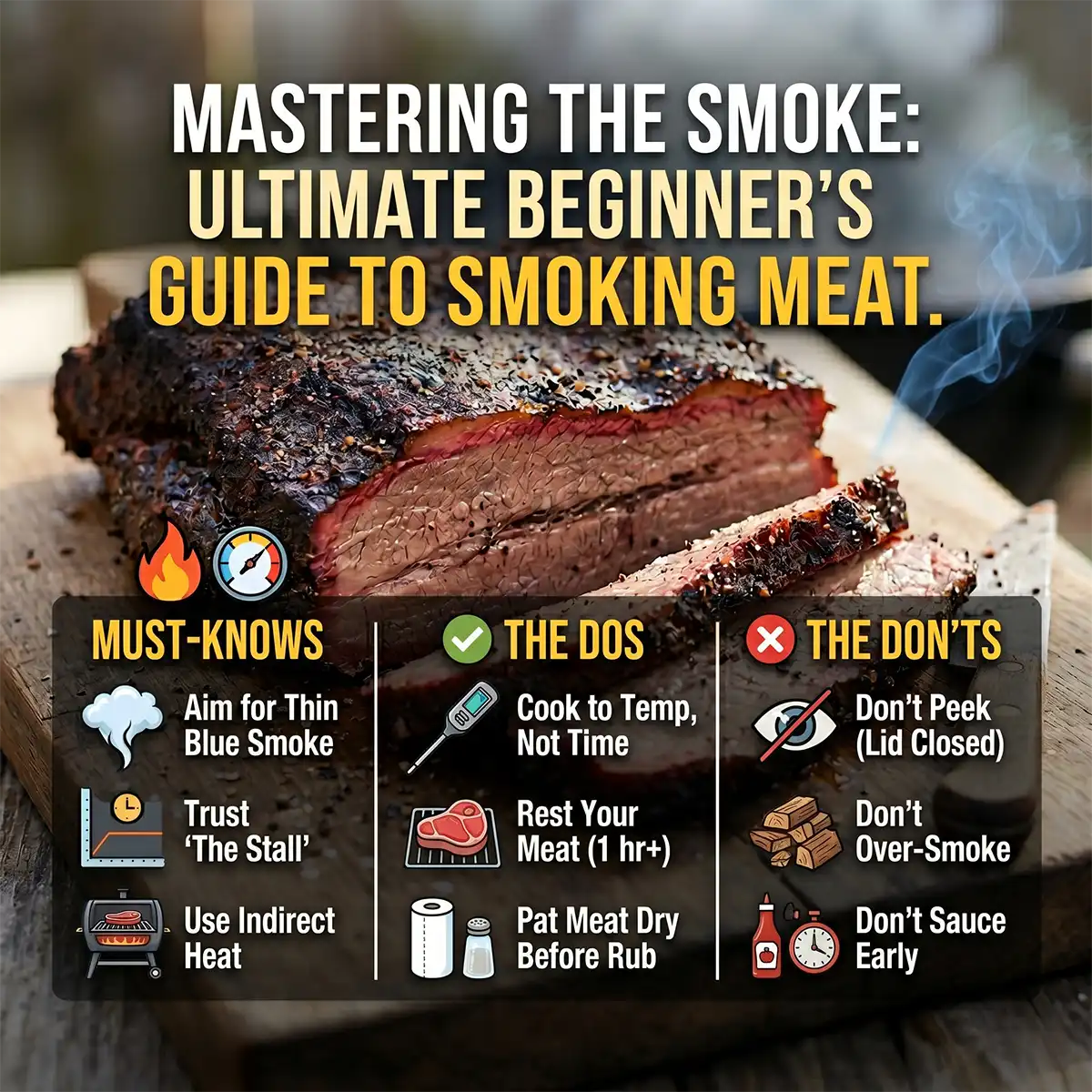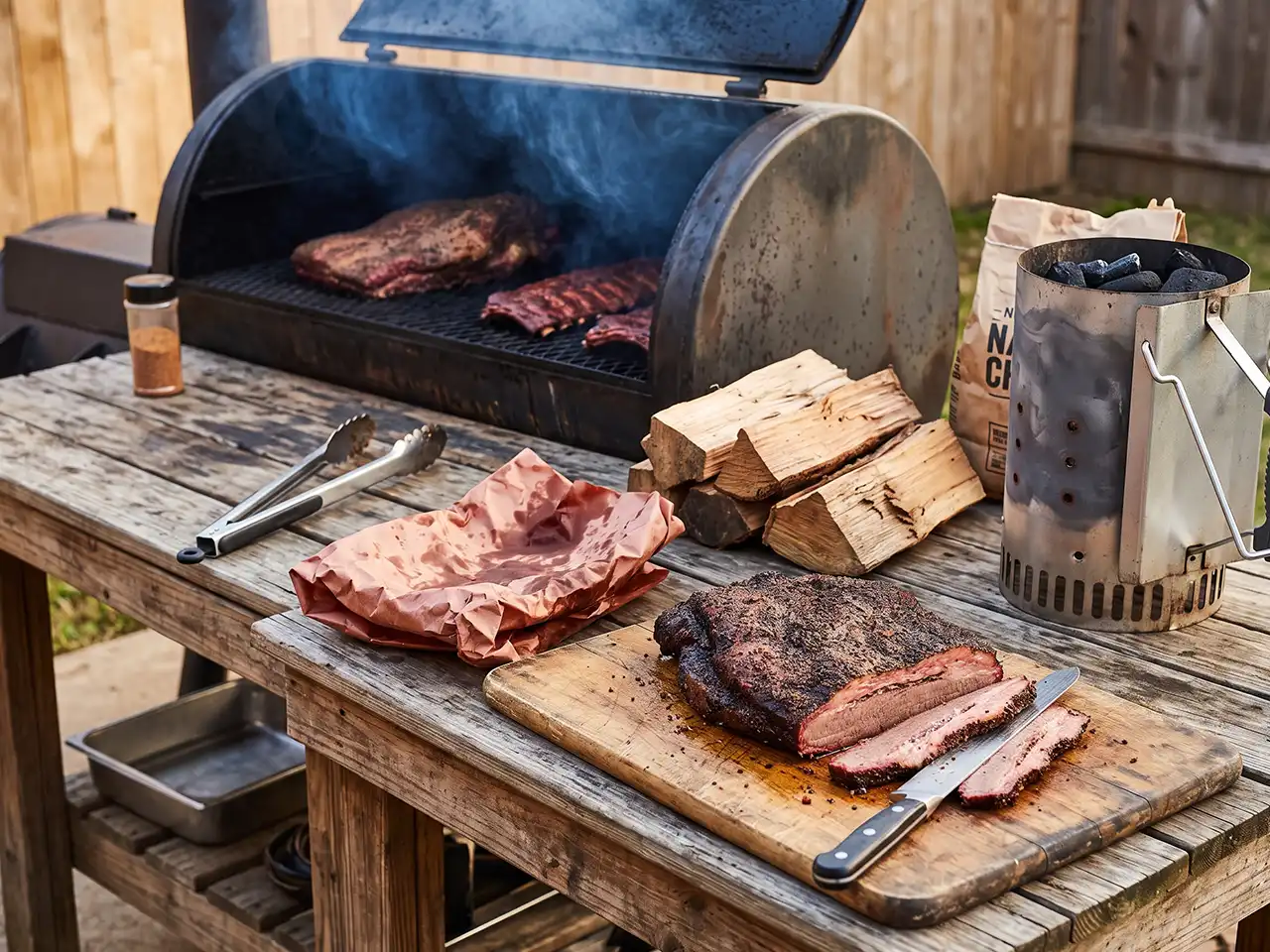
Stepping into the world of barbecue means learning a whole new vocabulary. Whether you’re tracking forum threads, watching competition cooks, or reading recipes, terms like the stall, blue smoke, and Texas crutch come up constantly. Knowing the terminology helps you understand the science behind heat, wood, and meat so you can troubleshoot cooks and run your smoker with confidence.
Here is the definitive A-to-Z glossary of essential barbecue terms every backyard pitmaster should know.
Techniques & Science
- Bark
- The dark, savory, deeply concentrated crust that forms on the surface of smoked meat. It results from the Maillard reaction, fat rendering, spice caramelization, and prolonged smoke vapor interaction.
- Blue Smoke (Thin Blue Smoke)
- The holy grail of barbecue smoke. It appears faintly blue, almost translucent, indicating clean, complete combustion of wood. Unlike thick white or gray smoke (which deposits bitter creosote), blue smoke produces sweet, clean flavor.
- Carryover Cooking
- The continued rise in internal meat temperature (typically 5°F to 10°F) after removing the cut from the smoker, driven by residual heat moving from outer layers toward the core.
- Dry Brining
- Salting meat 12 to 24 hours prior to cooking and resting it uncovered in the refrigerator. The salt draws out surface moisture, dissolves into a concentrated liquid brine, and diffuses back into the muscle fibers, improving moisture retention and surface drying for better bark formation.
- Low and Slow
- The core barbecue method of cooking large, tough cuts of meat over indirect heat at lower temperatures (typically 225°F to 275°F) for extended periods to melt collagen into gelatin without drying out the muscle.
- Pellicle
- A thin, slightly tacky protein film that forms on meat surfaces when exposed to cool, circulating air (such as an overnight dry brine). A well-set pellicle helps smoke adhere evenly.
- Reverse Sear
- A two-stage cooking technique where thick cuts (like steaks or tri-tip) are smoked or roasted gently at low heat until they approach target doneness, then finished over searing direct heat for a deep, charred crust.
- Smoke Ring
- A pink layer beneath the bark formed when nitric oxide (NO) and carbon monoxide (CO) from wood combustion bind with myoglobin in the meat. While prized visually, it is a byproduct of combustion gases, not an indicator of smoke flavor.
- The Stall
- The plateau phase during a low-and-slow cook—typically occurring between 150°F and 170°F internal temperature—where evaporative cooling balances heat input, causing temperature to flatline for hours until surface moisture fully evaporates.
- Texas Crutch
- The technique of wrapping meat tightly in aluminum foil (or butcher paper) during the stall with a splash of liquid to halt evaporative cooling, accelerate cooking times, and soften the bark.
- Wet Brining
- Submerging meat (commonly poultry or pork chops) in a saltwater and aromatic solution to introduce extra moisture before cooking.
Meat Cuts & Anatomy
- Baby Back Ribs
- Pork ribs cut from along the spine, underneath the loin muscle. They are shorter, curved, and generally leaner than spare ribs.
- Boston Butt (Pork Butt)
- Despite the name, this cut comes from the upper shoulder of the pig. Packed with marbling and connective tissue, it is the primary cut used for pulled pork.
- Burnt Ends
- Traditionally the cubed, doubly seasoned, and caramelized pieces cut from the fatty point of a smoked beef brisket. Modern variations also include pork belly burnt ends.
- Flat (Brisket Flat)
- The leaner, broader half of a whole packer brisket (pectoralis profundus). Sliced across the grain for clean, uniform slices.
- Packer Brisket (Full Packer)
- An untrimmed, whole brisket containing both muscles: the flat and the point, separated by a layer of fat (the deckle).
- Picnic Shoulder
- The lower half of the pork shoulder directly below the Boston butt, often sold with skin and bone attached.
- Point (Brisket Point / Deckle)
- The heavily marbled, triangular muscle (pectoralis superficialis) sitting atop the flat. Famous for rendering into rich, tender burnt ends.
- St. Louis Cut Ribs
- Pork spare ribs with the sternum bone, cartilage, and rib tips trimmed off, resulting in a clean, rectangular rack that cooks evenly.
Hardware, Fuels & Tools
- Baffle / Tuning Plates
- Metal plates placed inside an offset smoker’s cook chamber to deflect radiant heat from the firebox and distribute airflow evenly across the grates.
- Chimney Starter
- A vented metal cylinder used to light charcoal quickly and evenly using paper or firestarters without lighter fluid.
- Creosote
- A thick, black, oily byproduct of incomplete wood combustion. It creates a sooty, bitter, acrid coating on meat when smokers lack sufficient airflow.
- Lump Charcoal
- Hardwood burned down in the absence of oxygen to create natural carbon fuel. Burns hotter and produces less ash than briquettes.
- Minion Method
- A charcoal management technique for drum and bullet smokers where lit coals are placed over a bed of unlit charcoal and wood chunks, allowing a slow, controlled burn for long cooks.
- Offset Smoker (Stick Burner)
- A smoker design featuring a firebox attached to the side and slightly below a horizontal cooking chamber, drawing heat and smoke across the grates to an exhaust stack.
- Pellet Grill
- An outdoor cooker that automatically feeds compressed hardwood sawdust pellets via an auger into a small burn pot, regulated by an electronic PID controller.
- Snake Method
- A method for running long, low-and-slow cooks in a kettle grill by arranging briquettes in a curved line along the outer rim, lighting one end to burn progressively around the bowl.
- Water Pan
- A pan filled with water placed between the heat source and meat to stabilize cooking chamber temperatures and increase relative humidity inside the pit.