Stop adjusting your vents. Stop fighting the fire. It’s time to learn the physics of the cook.
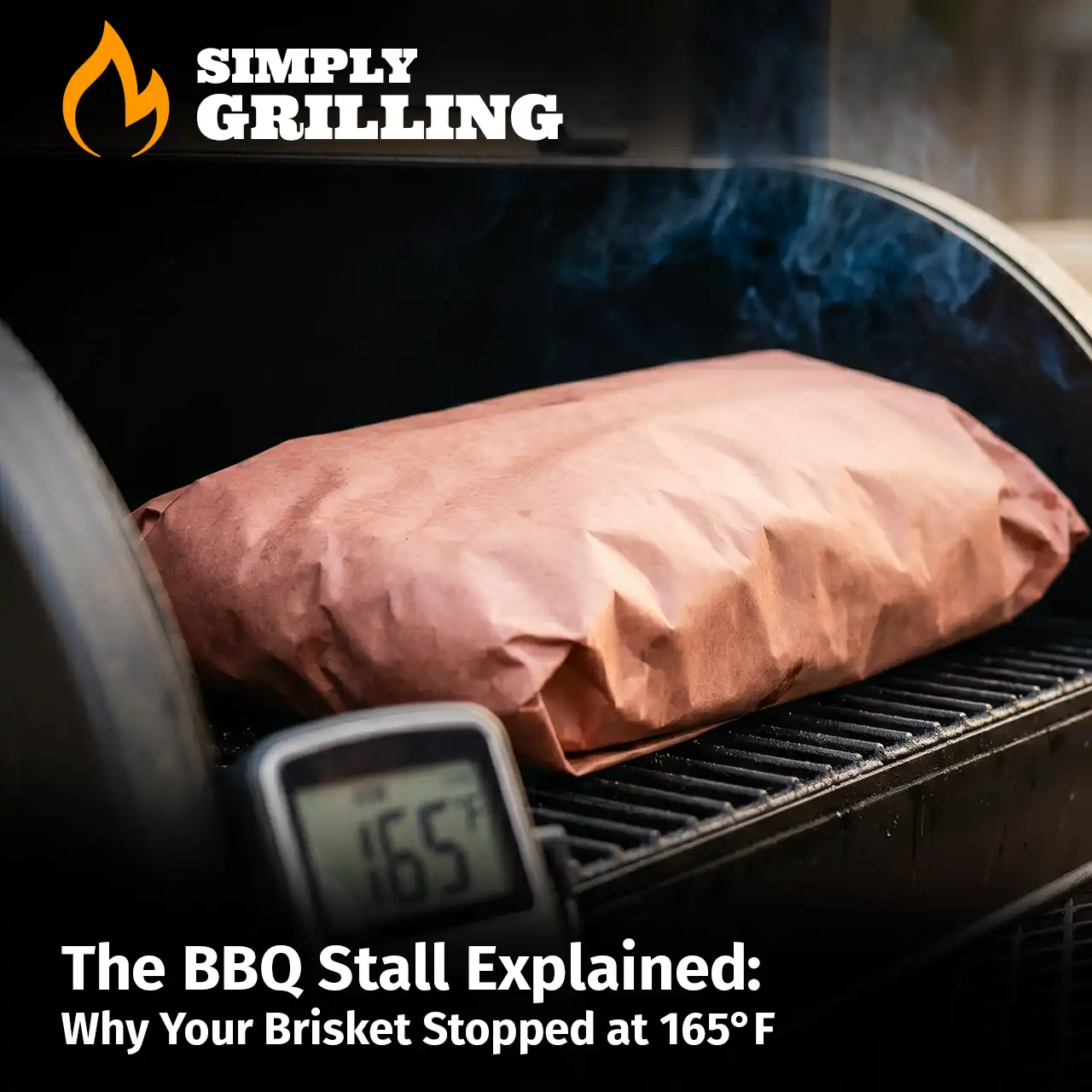
You managed your fire perfectly for six hours. The brisket steadily climbed to 165°F. And then… it hit a brick wall. For the next three hours, the temperature didn’t move a single degree. Welcome to the panic zone.
Every backyard cook has been there. You are hosting a party, the guests are getting hungry, and your digital thermometer has been stuck at 165°F since noon. The natural instinct is to panic. You open all the vents, you throw another log on the fire, you crank the heat to 350°F, and you completely dry out a $90 piece of meat.
If you want to master long, low-and-slow cooks like pork shoulder and brisket, you need to understand exactly what is the bbq stall. Because once you understand the physics behind it, you stop panicking, and you start controlling the cook. Here is the truth about the stall, the science that proves the old pitmasters wrong, and the exact techniques you need to power through it.
The Myth: It Is Not Melting Collagen
If you go on any old-school barbecue forum, you will hear the same tired myth: “The stall happens because the tough collagen and fats are finally breaking down and rendering. That process absorbs all the heat, causing the temperature to pause.”
That is completely false. Food scientists and thermodynamic experts debunked this over a decade ago. You can put a pure, lean clod of meat with zero fat and zero collagen in a smoker, and it will still stall. The stall has absolutely nothing to do with rendering fat or breaking down connective tissue.
The Science: Evaporative Cooling
So, what is the bbq stall, really? It is evaporative cooling. Your meat is sweating.
A raw brisket is about 70% water. As the internal temperature of the meat rises, those muscle fibers contract and squeeze moisture out to the surface. When that moisture hits the hot airflow of your smoker, it evaporates.
Think about what happens when you sweat on a hot summer day. The evaporation of sweat cools your skin. The exact same physical process is happening to your brisket. The meat is sweating, and that evaporation cools the surface of the meat.
Around 160°F to 165°F, the rate of evaporative cooling perfectly matches the heat output of your smoker. It is a thermodynamic stalemate. The smoker is pushing heat into the meat, but the evaporating moisture is cooling the meat at the exact same speed. The internal temperature will not rise again until the surface of the meat dries out enough for the evaporation to slow down. That can take anywhere from two to six hours.
How to Beat the Stall: Choose Your Weapon
You have three choices when you hit the stall. Your decision depends entirely on how much time you have and what kind of bark (crust) you want.
-
Weapon 1: The Texas Crutch (Heavy Duty Aluminum Foil)
- The Method: Pull the meat at 165°F and wrap it tightly in a double layer of heavy-duty aluminum foil.
- The Result: The foil creates an impermeable barrier. The moisture can no longer evaporate into the smoker, meaning evaporative cooling completely stops. You will power through the stall in a fraction of the time.
- The Catch: Because you trapped all that moisture, you are essentially steaming the meat. Your beautiful, hard-earned, crunchy bark will turn soft and mushy.
-
Weapon 2: Pink Butcher Paper (The Professional Choice)
- The Method: Wrap the meat tightly in unlined, food-grade pink butcher paper.
- The Result: This is the compromise that made Aaron Franklin famous. Butcher paper traps some heat and moisture, helping you push through the stall faster than leaving it naked. But unlike foil, paper is porous. It breathes. It allows enough steam to escape so that your bark doesn’t turn into a soggy mess. It retains the smoky flavor, speeds up the cook, and protects the crust. This is the gold standard.
-
Weapon 3: Let it Ride Naked
- The Method: Do absolutely nothing. Leave it on the grates.
- The Result: This is for the purists. If you refuse to wrap, you will eventually beat the stall. The surface moisture will eventually dry up, the stall will break, and the temperature will start climbing again.
- The Catch: You need infinite patience. A naked cook will add hours to your total time. You also risk drying out the edges of the meat if your smoker’s airflow is too aggressive. However, if you survive, you will be rewarded with the thickest, crunchiest, most intense bark possible.
Essential Gear for Beating the Stall
If you want to protect your bark while speeding up the cook, you need FDA-approved, unbleached, unwaxed pink butcher paper. Do not use freezer paper—the wax will melt onto your meat.
Check Price on AmazonYou can’t track the stall if you don’t know your exact internal temperature down to the decimal. Stop opening the lid to check. Use a professional-grade wireless thermometer like the ThermoWorks Signals or RFX to track the stall from your phone.
Check Price at ThermoWorksThe Bottom Line
The stall is not magic, and it is not a mistake. It is basic physics. Now that you know exactly what the bbq stall is, stop fighting your fire. When you see that thermometer freeze at 165°F, either wrap it in pink butcher paper to push through, or grab a beer, sit back, and let the thermodynamics run their course.