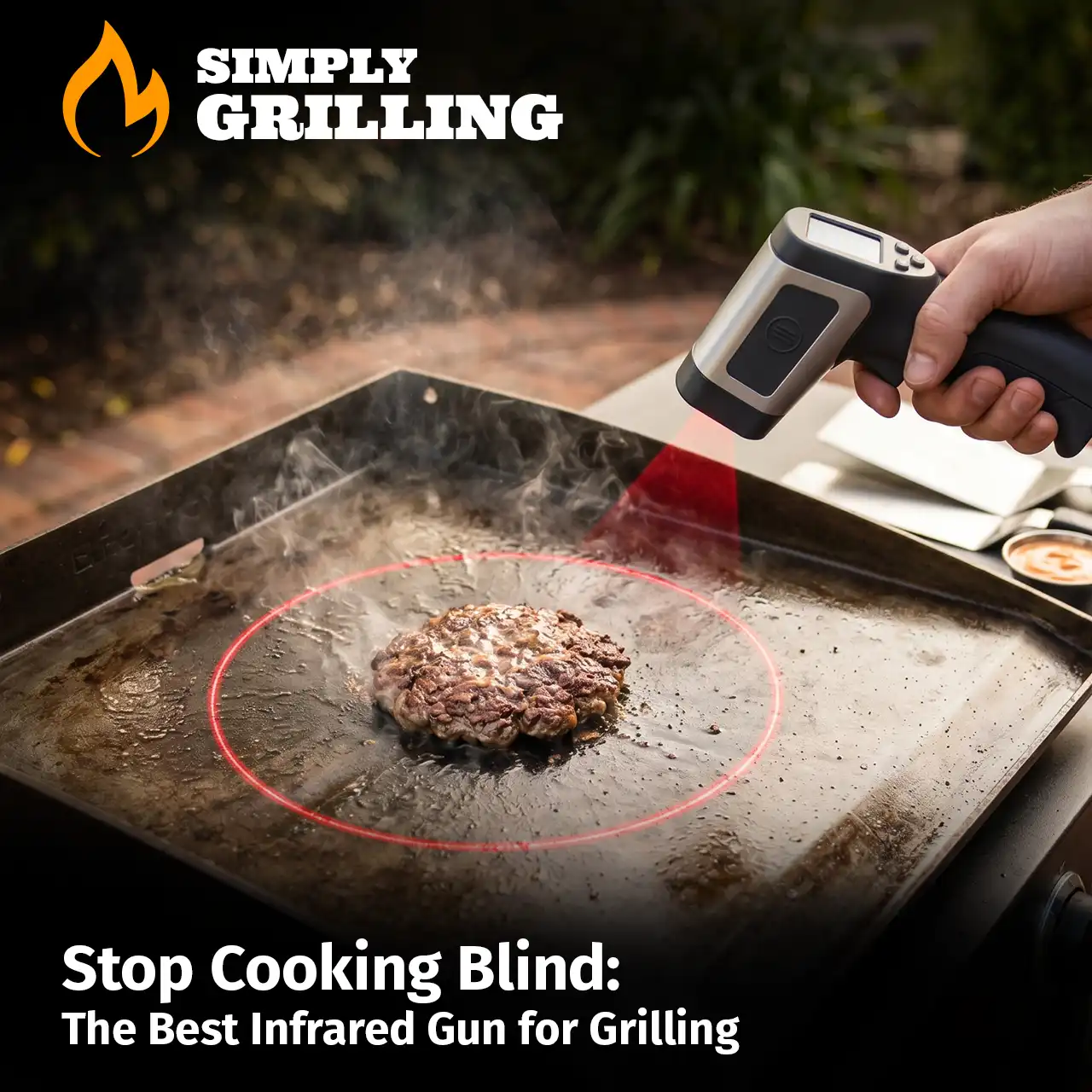
You know the internal temperature of your meat, but do you know the temperature of your steel?
We preach the gospel of the instant-read meat thermometer relentlessly. If you don’t know the internal temperature of your pork chop or brisket, you are just guessing. But there is a second half to that equation that most backyard cooks completely ignore: Surface Temperature.
Your dome thermometer tells you the ambient air. Your meat probe tells you the internal carryover. But neither of those tells you if your flat top griddle is about to instantly vaporize your cooking oil, or if your pizza stone is hot enough to blister dough without burning it.
To master the sear, you need an Infrared (IR) Thermometer. But not all IR guns are created equal. If you buy a cheap plastic toy, it will lie to you. Here is why you need a high-quality IR gun, and the definitive guide to the only ones worth your money.
The Holy Trinity of Surface Temp: Griddles, Searing, and Smoke
Why is an IR gun mandatory for a serious outdoor kitchen?
-
1. Mastering the Flat Top Griddle
Your Blackstone or Camp Chef griddle does not heat evenly. You have hot spots and cold zones. If you drop a smash burger onto a 350°F zone, it will steam and stick. If you drop it onto a 500°F zone, you get that ultimate, lacy crust. An IR gun allows you to map your griddle, knowing exactly where to sear steaks, where to scramble eggs, and when your steel is too hot for your oil’s smoke point. -
2. The Perfect Searing Grate
You reverse-seared a Tomahawk ribeye, and now it’s time to build the crust. If you throw it onto a 400°F cast iron grate, you get weak, grey grill marks. You need that grate pushing 600°F+. Point an IR gun at the grate, and you eliminate the guesswork. -
3. Pizza Ovens and Fireboxes
Cooking Neapolitan pizza requires a stone temperature of exactly 700°F to 800°F. If the stone is too cold, the dough sticks and tears. If it’s too hot, the bottom turns to charcoal before the cheese melts. An IR gun is the only way to check this safely.
The Contenders: Stop Buying Cheap Plastic Toys
When it comes to IR guns, the most important metric is the Distance-to-Target Ratio (Optics). A cheap 8:1 ratio means if you stand 8 inches away, it measures a 1-inch circle. If you stand two feet back, it’s measuring a massive area, averaging out the temperature of your hot grate and the cold air beneath it. You need precision.
The Trap: Generic $20 Amazon IR Guns
The Verdict: You have seen these red and yellow plastic guns everywhere. They have terrible optics (usually 8:1), meaning they average out too large of an area to be accurate. They have fixed emissivity (they can’t adjust for shiny stainless steel vs. matte cast iron), and their max temperature tops out around 600°F. If you try to measure a searing-hot pizza stone, it just reads “ERROR.” Throw it in the trash.
The Mid-Tier: Hardware Store Brands
The Verdict: Brands like Klein Tools or entry-level Fluke units have better build quality and decent battery life, but they still rely on single-dot lasers, which don’t show you the actual area being measured. These are built for HVAC guys checking air conditioning ducts, not for pitmasters managing a 700°F live fire. They lack the specific high-heat ranges required for culinary use.
The Only IR Guns Worth Your Money
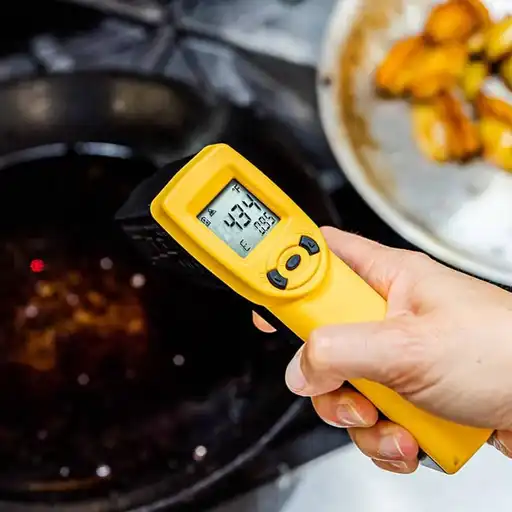
The Verdict: ThermoWorks is the absolute authority in culinary temperature, and their Industrial IR Gun is a masterpiece. Instead of a single laser dot that leaves you guessing exactly what is being measured, the IR-GUN-S projects a highly visible Circle Laser. The circle perfectly outlines the exact surface area being measured, so you know you are hitting your cast iron skillet and not the burner beneath it.
It boasts a 12:1 optical ratio, meaning you get pinpoint accuracy from a safe distance without singeing your arm hair. It reads all the way up to 1022°F (550°C), making it perfect for roaring charcoal beds and raging pizza stones. More importantly, it features adjustable emissivity, meaning you can tune it to read shiny griddle tops or matte black cast iron with dead-on accuracy. If you own a flat top griddle or a serious grill, this is the only IR gun you should be looking at.
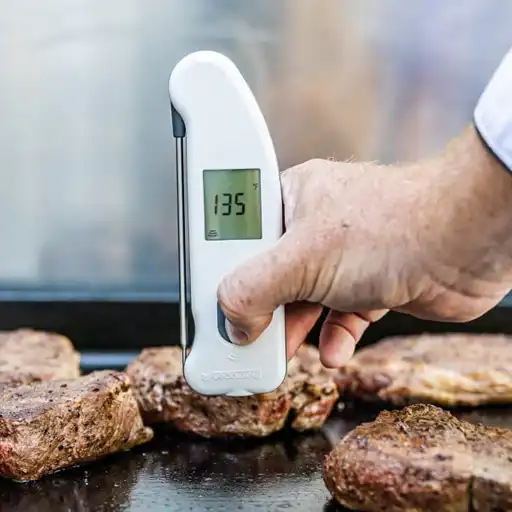
The Verdict: What if you refuse to carry two different thermometers out to the grill? ThermoWorks took their legendary, lightning-fast Thermapen and built a precision IR lens directly into the hinge. This is the ultimate problem solver.
You walk out to the grill, point the base at your griddle top to confirm your steel is at a blistering 500°F. You drop your steaks. When it’s time to check the carryover, you unfold the probe and get a dead-accurate internal reading in under 3 seconds. It features adjustable emissivity, a max IR range of 661°F, and the absolute bulletproof waterproof construction you expect from the Thermapen line. It completely eliminates the need to buy and store two separate devices. It is the pinnacle of outdoor cooking convenience.
The Bottom Line
If you are still holding your hand over a griddle and whispering “yeah, that feels pretty hot,” you are rolling the dice with your food. Step up your game. Buy a dedicated, high-quality IR gun, map your heat zones, and start cooking with absolute precision.