Transform everyday store-bought blocks into rich, complex, artisan smoked cheese right in your backyard—without melting a single ounce.
Cold smoking cheese is one of the highest-reward, lowest-effort projects you can tackle on your smoker. Unlike traditional hot smoking where we aim for 225°F to 275°F, cold smoking introduces pure wood smoke flavor at ambient temperatures—keeping the chamber strictly below 90°F (and ideally under 75°F) so the cheese retains its firm texture and fats don’t separate.
Best Cheeses for Cold Smoking
Semi-hard and hard cheeses hold their structure best and absorb smoke evenly without sweating excessively. Soft cheeses like brie or fresh mozzarella can be smoked, but require stricter temperature control and shorter smoke windows.
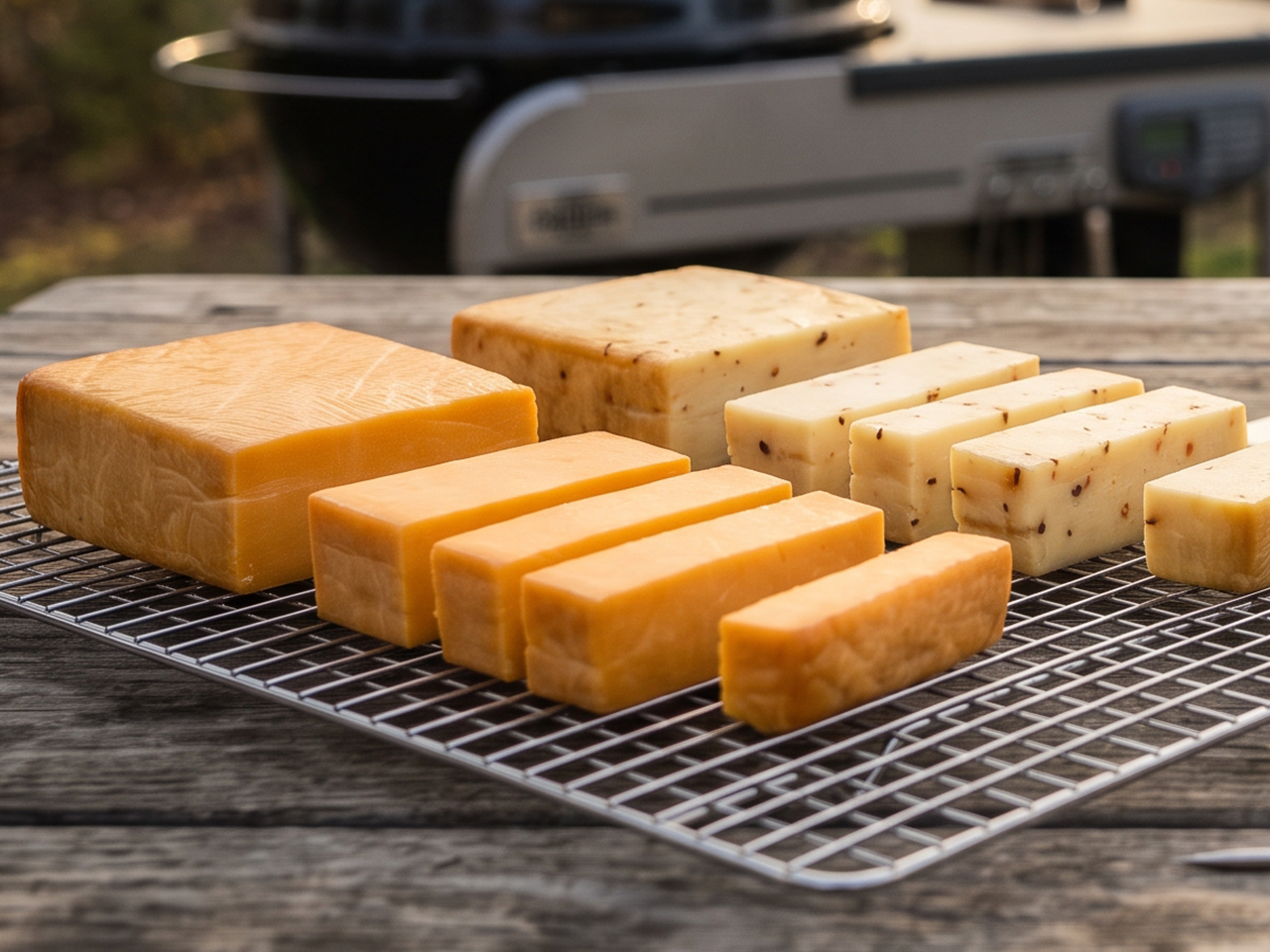
Sharp & Extra Sharp Cheddar
The gold standard. Holds up to heavier woods like hickory or oak and develops deep, savory richness after resting.
Gouda & Provolone
Naturally creamy with mild sweetness that pairs effortlessly with fruitwoods like apple or cherry.
Pepper Jack & Colby
Great for melting applications later—burgers, queso, and mac & cheese get an instant flavor upgrade.
Best Smokers & Setups for Cold Smoking
Because you are generating smoke without running a primary fire, almost any enclosed grill or smoker can be converted into a cold-smoking chamber.
| Smoker Type | How to Set It Up | Pro Tip |
|---|---|---|
| Pellet Grill (Unplugged) | Leave the grill turned off. Place a lit pellet smoke tube on the grates (or in the burn pot area with grates removed) and put cheese on the upper rack. | Keep the chimney cap wide open for clean airflow so stale smoke doesn’t settle on the cheese. |
| Offset Smoker | Place a smoke tube or maze inside the firebox with the damper cracked, and load your cheese in the far end of the main cook chamber. | The long distance between firebox and cook chamber naturally cools the smoke before it hits the cheese. |
| Kettle Grill / Kamado | Put a lit smoke tube on one side of the charcoal grate and place cheese on the opposite side of the cooking grate. | Place a foil pan filled with ice directly under the cheese to buffer against radiant heat. |
| Dedicated Cold Smoke Generator | External Venturi or maze generators attach to the side of vertical cabinets or custom boxes, piping cool, filtered smoke inside. | Best option for large batches when stocking up for holidays or gifting. |
Choosing the Right Wood
Since cheese absorbs smoke rapidly and has no bark or crust to filter it, aggressive woods can quickly turn bitter. Stick to clean, 100% hardwood pellets or sawdust with zero binders or fillers:
- Apple & Cherry: Mild, slightly sweet, and forgiving—ideal for beginners, Gouda, Swiss, and Havarti.
- Pecan & Maple: Nutty, balanced warmth that shines on cheddar, Colby Jack, and cream cheese.
- Hickory & Oak: Bold and traditional. Use sparingly (2 to 3 hours max) on extra-sharp cheddar or parmesan.
Cold Smoking Cheese: Essential Do’s and Don’ts
- Cut blocks into smaller portions: Slice 2-lb blocks into 8-oz bars so smoke penetrates evenly and gives you more surface area.
- Let cheese come to room temp for 20 minutes: Cold cheese straight from the fridge attracts condensation, which turns smoke into bitter creosote.
- Flip halfway through: Turn blocks over at the 1.5- to 2-hour mark so the grate side gets equal exposure.
- Vacuum seal and rest for at least 2 weeks: Freshly smoked cheese tastes harsh and ashtray-like; mellowing in the fridge lets the smoke equalize through the paste.
- Don’t eat it right off the smoker: Give it a minimum of 14 days (3 to 4 weeks is even better) sealed in the refrigerator before slicing.
- Don’t let chamber temps cross 90°F: Once butterfat begins to weep (“sweating”), the texture turns grainy and oily.
- Don’t use mesquite: Mesquite burns too sharp and acrid for delicate dairy fats.
- Don’t choke down the exhaust vents: Trapped, stagnant smoke deposits bitter residue on the surface. Keep air moving gently.
Step-by-Step Cold Smoke Workflow
- Prep & Dry the CheeseCut cheese into 1-inch to 1.5-inch thick bars, pat completely dry with paper towels, and rest on a wire cooling rack for 20–30 minutes so the surface is tacky, not wet.
- Light Your Smoke TubeFill a 12-inch pellet tube with apple or pecan pellets, light the open end with a propane torch, let the flame burn for 5 minutes, then blow it out so it smolders cleanly.
- Monitor Chamber TempPlace a digital ambient probe right next to the cheese on the grate. Smoke for 2 to 4 hours depending on how bold you want the flavor, flipping halfway.
- Air Out & Vacuum SealPull the cheese, pat off any surface moisture, and let it breathe in the fridge uncovered on a rack for 2 hours. Vacuum seal each block, label with the date and wood used, and age in the fridge for 2–4 weeks.