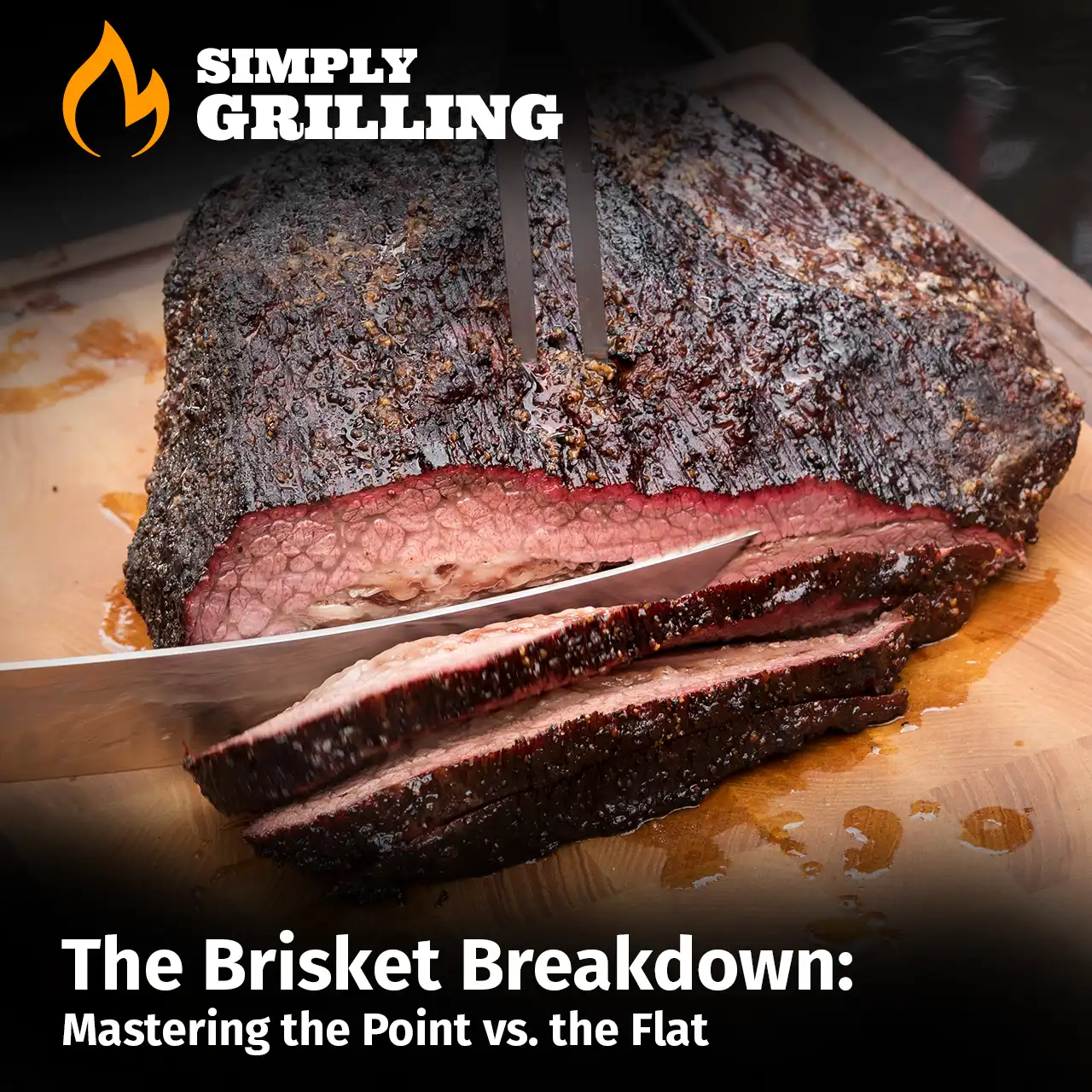
Brisket is universally recognized as the holy grail of backyard barbecue. It’s the ultimate test of patience, fire management, and technique. But one of the biggest reasons beginners struggle to nail the perfect brisket is a fundamental misunderstanding of the meat itself.
A whole packer brisket isn’t just one big slab of beef—it is actually two distinct muscles joined together by a thick layer of fat. Here at Simply Grilling, we see countless pitmasters treat the entire packer as a single uniform piece of meat, which often leads to dry slices or under-rendered fat.
Today, we are breaking down the anatomy of the brisket: the Flat and the Point. Understanding the differences between these two muscles is the secret to mastering the perfect cook.
Muscle 1: The Flat (The Slicer)
When you see pictures of beautiful, uniform, pencil-thick slices of brisket draped over a knife, you are looking at the flat.
Characteristics of the Flat:
- Shape & Size: It makes up the majority of the whole packer brisket. It is long, rectangular, and (as the name suggests) relatively flat and even in thickness.
- Fat Content: The flat is a very lean muscle with very little intramuscular fat (marbling). It relies entirely on the fat cap sitting on top of it to stay moist during a long smoke.
- The Danger Zone: Because it is so lean, the flat is highly susceptible to drying out. If you overcook your brisket, this is the part that will turn to dry, crumbly pot roast.
Muscle 2: The Point (The Marbled Masterpiece)
Sitting on top of the flat at one end of the brisket is a thicker, bulbous muscle called the point. This is where the magic happens for true BBQ aficionados.
Characteristics of the Point:
- Shape & Size: It is thicker, rounded, and tapers off at the end. It sits on top of the flat, separated by a thick vein of deckle fat.
- Fat Content: The point is incredibly rich and heavily marbled with intramuscular fat. As this fat renders during a low-and-slow cook, it naturally bastes the meat, creating a succulent, melt-in-your-mouth texture.
- The Prize: The point is much more forgiving to cook because of its fat content. This is also the muscle used to create the legendary BBQ delicacy: Brisket Burnt Ends.
Why The Anatomy Matters For Your Cook
So, why does knowing this make you a better pitmaster? Because cooking a lean muscle and a fatty muscle connected to each other requires strategic fire management.
1. Smoker Positioning
Every smoker has a primary heat source. In an offset smoker, it’s the firebox; in a pellet grill, it’s the burn pot in the center or side. Because the point is thicker and packed with fat, it can handle—and actually needs—more heat to render properly. Always position your brisket so the thick, fatty point is facing the primary heat source. This protects the delicate, lean flat from taking the brunt of the heat and drying out.
2. Probing for Tenderness
When checking to see if your brisket is done (usually around an internal temperature of 200°F – 205°F), you must probe the flat, not the point. The point will feel like warm butter long before the flat is finished rendering. The thickest part of the flat is your true gauge for doneness.
3. Building the Bark
Because the brisket is so massive, it needs a robust, heavy seasoning to build a great bark and cut through the richness of the beef. We highly recommend using a bold, coarse rub. A heavy coating of The Cattleman’s Cure beef blend will give you that iconic, dark, peppery crust that adheres beautifully to both the lean flat and the rendering fat of the point.
4. Slicing: The Final Trap
You spent 14 hours smoking the perfect packer, only to ruin it on the cutting board. The muscle fibers (the grain) in the flat and the point run in almost opposite directions!
- First, slice the flat against the grain until you reach the section where the point sits on top of it.
- Once you reach the point, stop. Rotate the brisket 90 degrees, and slice the remaining point meat in half, directly down the middle, then slice it against its own grain.
Mastering the difference between the point and the flat is the turning point for any backyard griller. Respect the anatomy, position it wisely in your smoker, slice it correctly, and you will be serving up competition-grade brisket in no time.